The following is an excerpt from Section 6, titled “Reptilians” on pages 35 to 52 in my free PDF, The Hawaii UFO & Alien Report, published February 22, 2022.
Reptilians
Section 6
The Hawaiian “Moʻo” also called “Moko,” are an ancient dinosaur race that has been
known as dragons, Dracos, nagas, serpents, Seraphim, demons, and reptilians by other
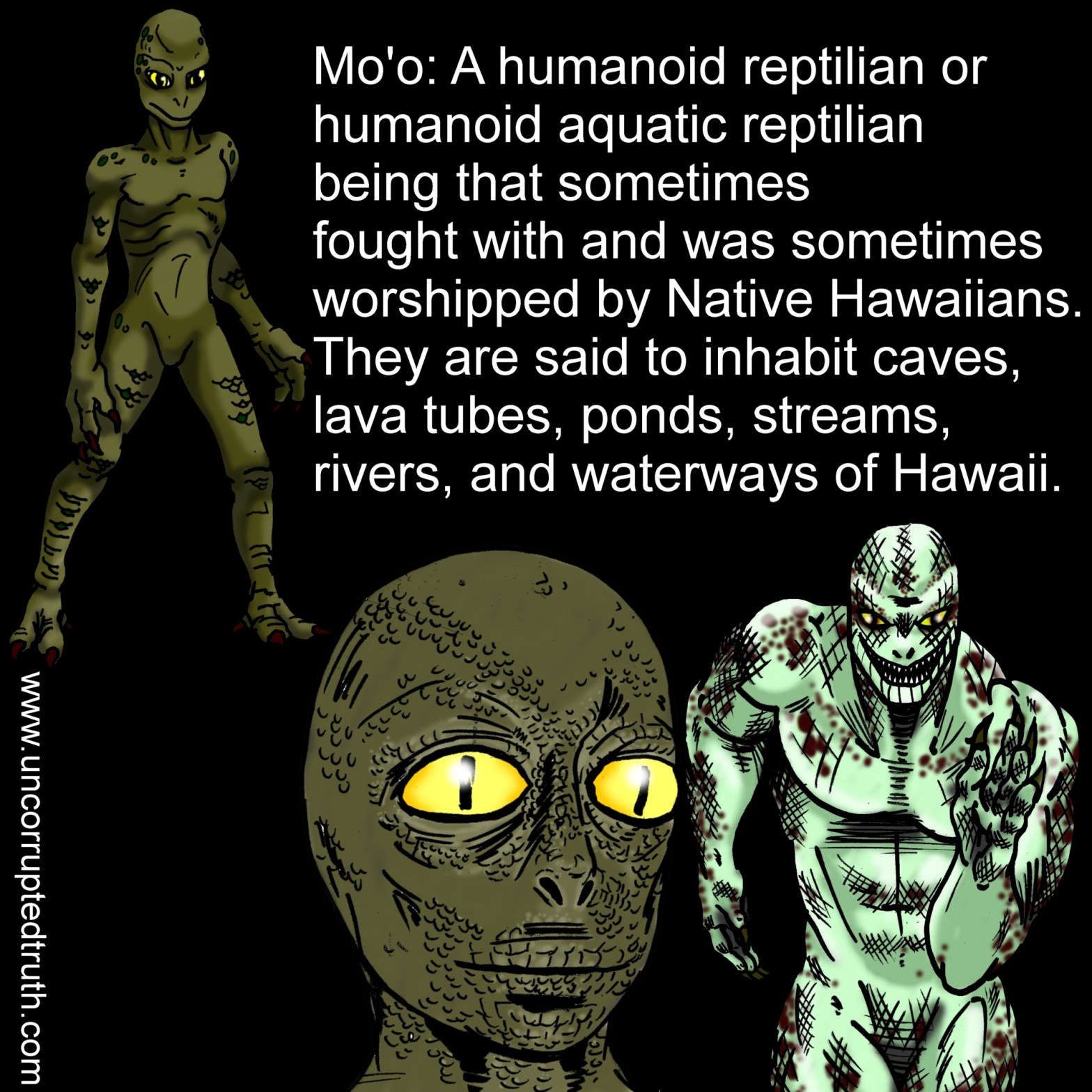
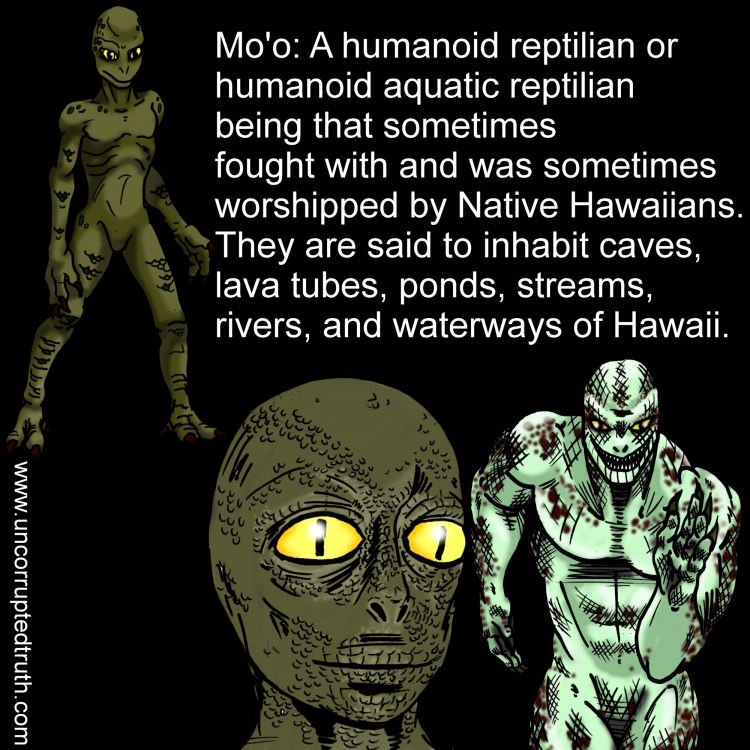
cultures. The Hawaiian Islands today are home to many small lizards and geckos but the Mo’o are not to be confused with their tiny modern cousins. Native Hawaiian language specifically associates the word Moʻo with dragon, serpent, and water spirit. Moʻo lele refers to flying serpents. The word Moʻo ahilele pertains to a fiery flying dragon as in European legend. Mo’o lau means lizard gods, monsters, spirits, and dragons. Moʻo akua are legends of god-like lizards, like the legends we will go into here.
Today, reptilians are also a modern topic connected to cryptids, UFOs and conspiracies.
In multiple Hawaiian legend source books, the Mo’o were described as more ancient deities
than more commonly known deity family of which Pele was a member. They are always
described as larger and taller than humans and were understood to be the guardians of water sources, including waterfalls, springs, streams, and fishponds. They were known to be the defenders of these sacred spaces against trespassers, engaging in battles that reverberated like earthquakes and left gashes and scars in the terrain. Often described as lizard people, the Hawaiians often carved wooden tiki to mark entrances or areas where these entities resided. The Moko figures were anthropomorphic, combining human hands and genitalia with bodies and heads of lizards.
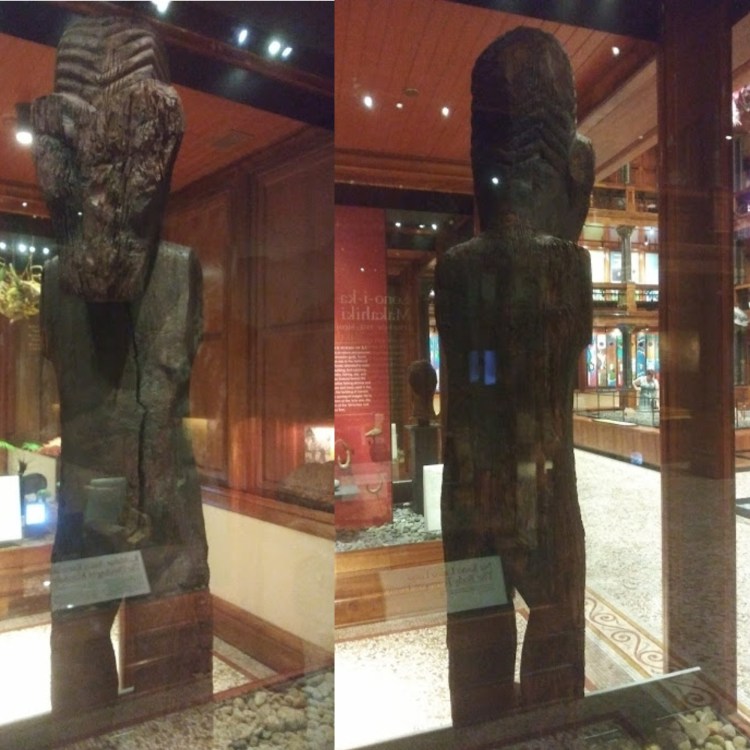
When the missionaries and Catholics came to Hawaiʻi, they burned, smashed, and
defaced many of the tikis and images of these Moko. Today, some of these tikis still survive at megalithic Nephilim burial places like “The City of Refuge” on the Big Island. The Hawaiians called this place “Puuhonua O Honaunau”, and it is now considered a national historic park. Visitors to Honaunau actually report a ball of light that travels throughout the park. This light may be a security drone or some other type of UFO. Other sightings of UFOs at the park have been reported flying 30 feet over the water. It is said that 22 Royal Chiefs once occupied the area. Twenty-two, a sacred number to many, is also the same number of strands in the human DNA. Also, at the site is a black and white, Hawaiian checkerboard game (konane), an interesting connection to ancient freemasonry. The site has blocks of stone too large for normal humans to move, and the entire place resembles many Celtic stone sites, Viking stone sites, and mounds in Britain and North America. In addition to these “giants’ mounds,” Puuhonua O Honaunau has tikis of many beings that could be considered reptilians and grey aliens. Perhaps this was a neutral city where these races held counsel. The giants and Mo’o were aware of each other and existed together in the past openly in places like Egypt, where you can see the green giant Osiris and the reptilian God Sobek.
Modern day UFO stories are filled with reports of reptilian humanoids, some UFologists
call these reptilians “the Draco.” Draco, short for Draconian, also is the root sound for the
English word Dragon or Drago. Hawaiians knew about reptilian humanoids and talked about them long before English speakers or Europeans arrived in Hawaiʻi. An example of a moʻolelo (Hawaiian story) depicting these reptilians is as follows: A boy named Kauawaʻahila and a girl named Kauakiʻowao who were the twin children of a chief ran away from home to live in Manoa Valley on Oʻahu. One day, they found a large pond named Kanewai and two small caves in Punahou. The sister would bathe in the pond and the boy would catch ducks there. While there, Kauawaʻahila met a Moʻo named Kakea who was in charge of all the water sources in Manoa and Makiki Valleys. The boy, Kauawaʻahila, asked if the Moʻo could create a small canal that would lead to the two caves where he and his sister were living. The Moʻo agreed, possibly because they were the children of a chief, and opened an underground tunnel to create a spring called Punahou spring. The brother built a wall around it and a garden, and the sister bathed there. Later it grew into a large community. We know that in modern times reptilians can be encountered guarding entrances to underground cities and cave systems. Did Kakea the Mo’o agree to channel some of the water away from pond in order to keep people away from an entrance to an underground reptilian base?
Rainbow Falls is a popular tourist attraction on the Big Island of Hawaiʻi. Fed by the 18
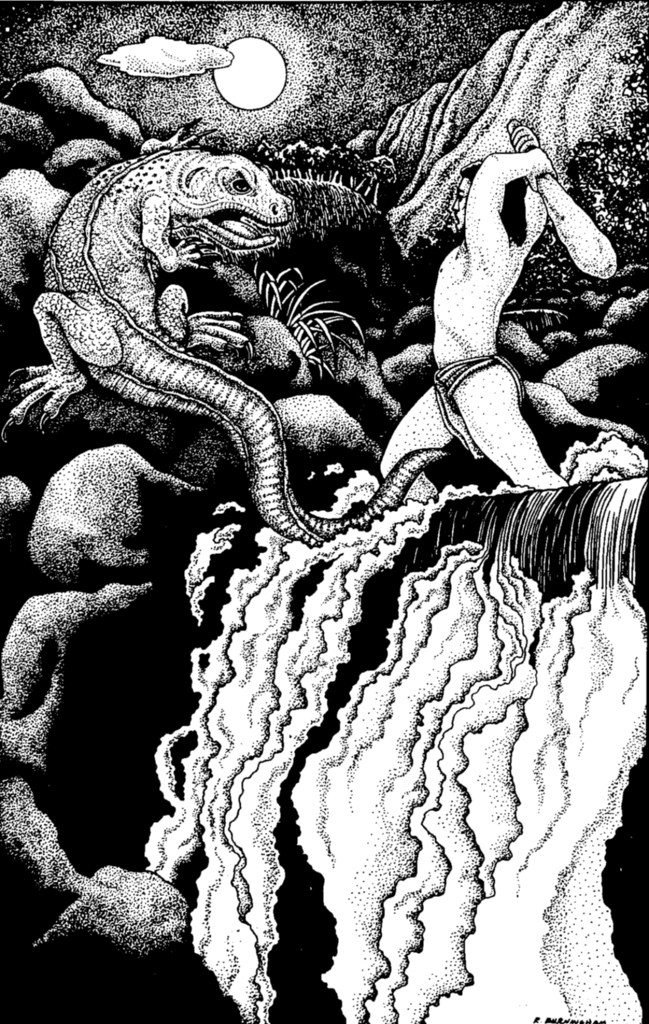
mile long, Wailuku River (“Waters of Destruction”), a waterfall 80 feet high and 100 feet wide can be seen to have rainbows appear in it, hence the modern name. What isn’t as prominent is the fact the Rainbow Waterfall was a battle ground between Hawaiians and a reptilian Moʻo. A Moʻo named Kuna was killed there. For Hawaiians, the waterfall symbolizes a great victory against the reptilians. The tale varies from source to source, but what is truly astonishing is that the event is marked with a plaque and artwork at the site. The general story, although embellished and altered for the public, says that Kuna the Moʻo would come out at night hoping to abduct, harm, or kidnap women who made bark cloth by the river. This led to what appears to be a war party that used clubs and heated rocks to pelt and corner the reptilian until they could push it off the waterfall’s edge. When the Moʻo fell, the Hawaiians covered it with more stones, burying it at the site. The story as told to the public is a fantasy version involving Pele the lava goddess, Hina or Mahina the Moon Goddess, and Maui the Giant, Hawaiian Superman. Most likely, Maui, who was a cunning warrior from Tahiti, was called to lead a war party against the reptilian who stalked the river and its inner-earth entrances. One and a half miles up from Rainbow Falls is Peʻepeʻe Falls (Peʻepeʻe means “hidden”) also called “Boiling Pots” an area where the river is intersected by nearby, underground lava tunnels. Killing a reptilian guarding these tunnels or area would be a difficult task and would take an organized effort on the part of
the humans. We can find a similar example in Europe of Saint George killing the Dragon. The Hawaiian Battle of Wailuku River and Saint George’s victory over the Reptilian Draco are two examples of a Human and Reptilian war that may still be happening today. Often times, even iron-clad armored Europeans would need many men on horseback with lances, shields, bows, arrows, and swords to overcome a reptilian or “slay a dragon.” One can only wonder with modern weapons how these battles are fought today.
Hawaiians were star watchers and navigated the oceans via the stars just like the
Phoenicians. When Makaliʻi (Pleiades) star cluster rises shortly after sunset, usually on
November 17, the rising of the following first crescent moon marks the beginning of an annual Hawaiian festival. From November to February, Hawaiians celebrated a time of sport, feast, and peace. They called this time of year Makahiki and this creates an important attachment for Hawaiians and the Pleiades star system. Offers were made to alters called Heiau. Heiau were used all over Hawaiʻi and even involved ritualistic human sacrifice.
Kealakekua Beach, on the Big Island, has a Heiau as well as another clue to other ways
Hawaiians delt with their reptilian island inhabitants. Today, Kealakekua beach is famous for being the place where five men were killed (one of them Captain Cook), and two were injured in a skirmish between the English and the Hawaiians. That is seven people total injured or dead, and one name for the Pleiades is the “seven sisters.” This battle happened on Valentine’s Day, February 14th, 1779, right at the end of the Makahiki time of no war. ‘C’ is the 3rd letter of the alphabet. Captain Cook who “discovered” Hawaiʻi for England (similarly to Christopher Columbus who “discovered” America for England) has the initials C.C., which translates to 33. Captain James Cook, like Christopher Columbus was a 33rd degree Freemason with access to pre-flood maps allowing them to know exactly where they were going. Mainstream’s historical narrative ridiculously wants people to believe that while Hawaiians knew where they were going via the stars, the British accidently and innocently stumbled on new lands with no intent to conquer. While Cook’s initials were J.C., same as Jesus Christ, Columbus has a combination of the name Christ and Columbia. Cook and Columbus, two captains who worked for England, where the Grand Freemason Lodge is, both had orders to conquer lands for the Monarchy and were ultimately successful. Was the death of Captain Cook ritualistically planned as a sacrifice to mark the end of the time of Makahiki? The location where Cook was killed, Kealakekua beach not only has a Heiau for sacrifice but is home to a known Mo’o pond.
While there in 2019, I was told by a local native Hawaiian that the Mo’o ponds at
Kealakekua beach were known as a place by Hawaiians where Mo’o lived and were seen. The Mo’o were seen so much that the Hawaiians would sometimes sacrifice children and adults and leave them at the Heiau for the Mo’o to collect. Sometimes they were thrown into the pond or given directly. The Hawaiians did this as a sort of payment, so that the Mo’o would stay at the pond and not come into the village to take more people away. Can we assume that the Hawaiians celebrated the Pleiades in the Makahiki festival of peace because this was the time when the Hawaiians did not have to give sacrifice to the Mo’o? Some say the natives of the Pleiades star systems are friends to humanity and are enemies with the reptilians.
Sacrificing women and children to dragons and demonic deities is not new and seems to
be a dynamic of the power structure here on Earth. Humans either war with them or pay them tribute to be left alone. It seems that the peoples of Hawaiʻi were in quite the relationship with the reptilians. Reptilians were in Hawaiʻi long before and after Captain Cook who is credited with “discovering” Hawaiʻi for the British Monarchy. Did the Hawaiians knowingly lure and sacrifice Captain Cook near a Heiau and Mo’o pond to pay their blood debts to the reptilians? Did the Illuminati intend and plan for James Cook (J.C.) who was “33” to be sacrificed on the esoteric holy day of Valentine’s Day in order to concoct an astrological spell? Let’s not forget “The Saint Valentine’s Day Massacre” in 1929 where 7 members and associates of Chicago’s North Side Gang were murdered. Was Captain Cooks’ death also a Valentine’s Day Massacre spell, with its numerology, done on 2/14 with 7 people? It seems to have worked because although the British lost Cook, they quickly took over the Hawaiian Monarchy in return. As soon as Kamehameha the 2nd was in power, he was already fully decorated and educated in Freemasonry. Today, there is a white, masonic obelisk marking the death of Captain James Cook off the coast of Kealakekua Bay. It is publicly displayed so that people may visit it, pay tribute, and worship it. Cook’s obelisk is like the many found at the Temple of Obelisk at Byblos where the Phoenicians are from.
Modern Hawaiʻi is home to many Japanese who brought Japanese culture with them.
The Japanese “Kappa” are reptilian humanoids who, like Hawaiian Mo’o, also lived in rivers,
ponds, lakes, or the sea. The Kappa had green, scaly skin, smelled foul and would come out at night to eat and drag children into their ponds. Kappa and Mo’o have the same modus operandi of a reptilian humanoid, dinosaurian race here on Earth. Like the Kappa and Mo’o, the modern alien reports state that some of these reptilian sightings are female. Some of these reptilian races are reported to be matriarchal and are controlled by Draco Queens. In the islands of Hawaiʻi, there seems to be many female reptilian stories in modern and ancient times. Stories in Hilo, Hawaiʻi in the 1940s and Kauaʻi in 1951 both reported children disappearing into ponds by supernatural means. The 1951 Kauaʻi incident involved over 2,000 people and was also covered by KTOH, a Honolulu radio station. Children abducted by waterway? Even in modern Hawaiʻi? In April 1957, half a dozen children attending Wahiawa Elementary School reported seeing a “green lady” with scaly skin and claws in a gulch behind the school. The principal was notified, and the police were called. The Wahiawa Chamber of Commerce organized a search, but nothing was found. Did the Hawaiʻi state government know something, that the witnesses didn’t? Did the authorities take it seriously because someone “high up” in government knows the validity of the Mo’o in Hawaiʻi? Makaha Elementary School children also reported a scaly green lady who lived in their pond behind the school in the 1960s. The 1957 and 1960s cases were both schools, both connected to water, both green scaly creatures and on Oʻahu.
According to Hawaiian legend, there was a Mo’o chiefess on Maui named Kiha-wahine.
Appearances of Kiha-wahine are reported from various places on Maui. The old fishpond at
Haneoo in the Hana district is still thought of as her home. When there is foam on the pond, she is at home, and fish caught at this time will be bitter in taste. Modern ideas give her the form of a woman. A fin-like projection of rock near the center of the pond called Lauoho (combing) is where she sits to comb her hair. Kiha-wahine is also reported from the pool of Maulili in Waikomo stream in Koloa, Kauaʻi. In the story of Puna-ai-koae she is the Mo’o woman who has a combat with Pele over the possession of the young chief as a husband.
Mokuhinia is another Mo’o aumakua belonging to Maui with appearances at various
places in West Maui. Mokuhinia’s most spectacular appearance was in 1838 when she showed herself to “hundreds of thousands” of people gathered at the pond of Mokuhinia. Lani-wahine is a Mo’o goddess of Ukoa pond, Waialua, on Oʻahu. She often appears in human form to foretell some terrible event. Kane-kuaana, yet another Mo’o, rules the land of Ewa between Halawa and Honouliuli and brings it prosperity. If fish were scarce, her relatives would erect waihau altars and light fires and the waters would be filled with pearl oysters and fine fish. Hau-wahine was the Mo’o goddess of the ponds of Kawainui and Kaelepule in Koolau district on Oʻahu. She brings abundance of fish, punishes the owners of the pond if they oppress the poor, and wards off sickness. Walinu’u and Wali-manoanoa are ancestral Mo’o for whom pillars were set up in the heiau as memorials and who are worshiped as female deities whom the Hawaiian
government depended on for prosperity.
Waka is another Mo’o goddess worshiped by female chiefs. She is romanticized as the
guardian of Paliuli on Hawaiʻi and of the protector of the young chief Kauakahiali’i on Kauaʻi. Mo’o-inanea is a firstborn child of Kane-huna-moku in Kuaihelani and head of the Mo’o family in Kuaihelani, before the emigration of the Ku and Hina family to Hawaiʻi. She is the man-eating ancestress of Aukelenuiaiku in Kuaihelani. In another mo’olelo, a Mo’o lived in a cave below a waterfall at Holua-manu in the mountains above Makaweli. A child was told to go to the Mo’o and live with her. She obeyed and the Mo’o treated her kindly and the girl was happy. The family however wished to recover her and succeeded in trapping her in a net. She was carried to Waimea where she gradually reintegrated into society and became a grown, beautiful woman, who married the ruling chief. There were many Mo’o deities in ancient Hawaiʻi with many who are named being female aumakua worshiped by chiefesses. Of course, not all Mo’o are female and there seems to be a fine line between worship and fear. There are mostly legends of conflict with unfriendly Mo’o.
Retired Honolulu Police Department officer “Buddy” Aldophson reported on July 26,
1952, about an incident at Waimea Falls. A Merchant Marine from Seattle named Bill Lawrence slipped and fell 40 feet off Waimea Falls while attempting to dive from it. The fall killed Bill and the event was witnessed by many. While trying to retrieve Bill’s body, his four merchant marine friends witnessed something grab Bill and drag him to the bottom of the pool. Police, firefighters, Bill’s friends, and 12 volunteers arrived on the scene, but could not find Bill’s body. With police permission, the four merchant marines camped in the Valley for an overnight vigil. The police arrived the next day to continue the search and met the men running out of the valley in terror. The four men said that around 10 pm as they camped, a creature crawled out of the pool and attacked them. The men said the creature stalked them, terrorized them, shook bushes, and then leapt over them, splashing into the pond. This harassment continued until 1 am in the morning when they began to hear horrible, guttural screams coming out of the water. The police finally found Bill’s body near the pond on what Hawaiians considered a sacrificial alter stone. When they started to move the body, all the water in the pool shot out and flooded the valley chasing the men out. The pool emptied and then refilled with clean clear water. It was known that in the same area in 1792 an ancient Hawaiian Chief, Koi, maintained a Waihe’e Heiau, a sacred temple where human sacrifice was performed. Koi had an army of tattooed men in Waimea Valley who on May 12, 1792, killed three men from the British Navy and sacrificed them. Was Waimea Falls, like Kealakekua Bay, another spot where the British Navy were ritualistically sacrificed to Mo’o reptilians? Waimea Falls was originally called Waihe’e Falls where Chief Koi’s Sacrificial Heiau was. From the 1930s to the 1980s all the victims who died at Waimea Falls were Caucasian males between the ages of 18-25 and in the military.
Was Waimea Falls a nearby cave entrance or an underwater hatch to an underground,
lava tube reptilian base, just like Rainbow Falls? In the 1952 Bill Lawrence police case, it seems that a reptilian guarding the entrance attempted to take the body of Bill then later tried to scare his friends away. When more people came, it seems the reptilian put Bills body out into view and then released some water valve to chase the rest of the humans out of the valley. Perhaps the Mo’o decided the body wasn’t worth the attention and gave it back to prevent anyone from accidently finding the hidden cave doors while searching for the body. Then, to keep people from crowding the area, the Mo’o decided that scaring all the humans away with a flood would solve the privacy problem. From these stories, we can see a consistency of locations such as waterfalls, caves, pools, ponds, waterways etc. and Mo’o or reptilian creatures often sighted near them. They often take human sacrifice and alters or Heiaus are nearby to accommodate them. It seems that the Mo’o were present in Hawaiʻi during Hawaiian, British, and American rule. Maui (the warrior hero) pushed a Mo’o off a waterfall on Big Island; while Koi a Hawaiian Chief, sacrificed humans to a Mo’o near a waterfall on Oʻahu. It seems different islands had different ways of dealing with Mo’o, from worship to war. What other options did the Hawaiians have?
‘Iao Valley in Maui was supposedly a major tunnel entrance that leads under the island
and to inner-Earth realms. To conquer Hawaiʻi, King Kamehameha went to ‘Iao Valley and used his cannons and army to collapse any tunnel entrances or caves that opposing tribes could shelter or escape in. Many warriors were killed, and the victory helped Kamehameha extinguish any opposition in Maui. Was the sealing of this cave entrance an important strategy for Kamehameha since it would prevent Mo’o or any other enemy from exploiting it against his conquest? Kamehameha himself knew the value of tunnels in Hawaiʻi very well. He was raised in, hidden in, protected by, and moved through the secret cave system of Kohala in his hometown. That is why no rival chiefs could find and assassinate Kamehameha as a child. Near the birthplace of Kamehameha is a sacrificial Heiau called Mo’okini. Pu’u kohola heiau near Spencer Beach and Uni Heiau on Hualalai Mountain may have also been places where sacrifice was made to Mo’o reptilians. So, like Kamehameha, if sacrifice and battle do not pacify the Mo’o, then perhaps simply sealing up the entrances and collapsing their caves is another
strategy.
Writer of the book “Hawaiian Mythology,” Martha Beckwith, documents: “The Mo’o that
guarded these ponds were not the common gecko or skink; no, indeed! One can guess at their shape from these little creatures but this is not their real form. They had a terrifying body such as was often seen in old days; not commonly, but they were often visible when fires were lighted on altars close to their homes. Once seen, no one could preserve his skepticism. They lay in the water from two to five fathoms in length (twelve to thirty feet) and as black in color as the blackest negro. If given a drink of awa they would turn from side to side like the keel of a canoe in the water.”
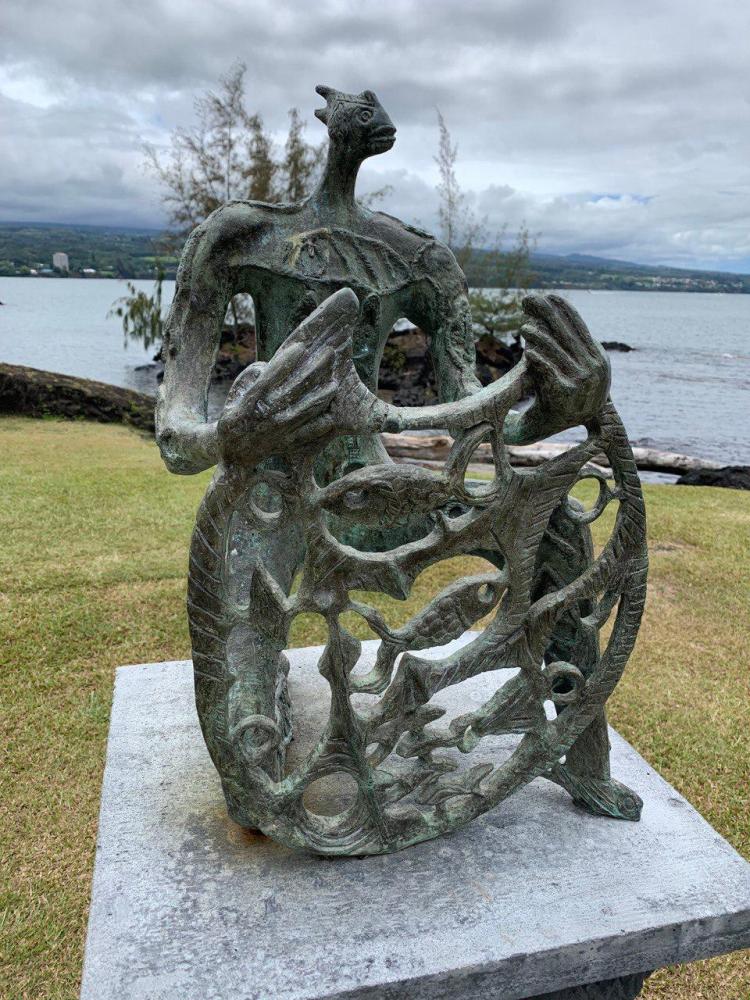
Hilo.
.
Where are the dinosaurian reptilian people now? Today, in downtown Honolulu, between
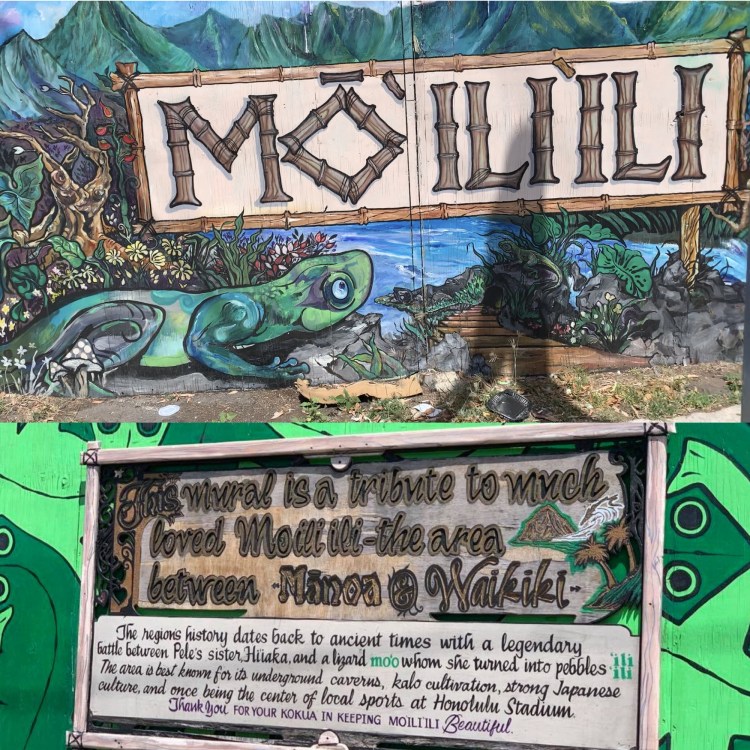
Waikiki and Manoa, is a district called Moʻilili named after the Moʻo. The region’s history dates back to ancient times with a legendary battle between Pele’s sister Hiʻiaka and a Moʻo in the area. The area was best known for its underground caverns, although a person today could not tell this by the traffic and commercial business that now dominate the area. Astonishingly, Modern Hawaiʻi named a heavily populated area after humanoid reptilians who lived in the caves beneath the neighborhood. Most people today are completely unaware of Moʻilili’s history. The only acknowledgement is a community mural decorated with reptilians and a plaque dedicated to the Moʻo. In modern day, the federal government often uses Native American reservations, farmland, national parks, nature reserves or wildlife refuges to hide government secrets. The National Park Service (NPS) is an agency of the federal government of the United States that manages all national parks, most national monuments, and other natural, historical, and recreational properties. The NPS is an operating unit of the United States Department of the Interior, and it is no mistake that these same agencies and locations are always attached to aliens and UFOs.
In his book series “Missing 411,” law enforcement veteran of twenty years, David
Paulides, catalogues and documents thousands of people who go mysteriously missing from National Parks and Forests in America and Canada every year. Often times, these hikers, campers, or tourists fall victim to abduction from unknown sources never to be seen again. Underground CIA, military, and NSA bases are often under farm land, which is why many UFO sightings are over farm land. Likewise, dense forests and mountain locations make excellent cover for secret entrances into underground networks or bases. If the government is aware of the Mo’o reptilians (and you can be sure they are), then, it is not hard to imagine that they are also working together and have agreements with these beings just as the Hawaiian Ali’i did in the past. If the ancient peoples were giving the reptilians roaming space and sacrifice as a part of some deal, like the Hawaiians did, then it is only normal to assume that those customs continue in modern times. National parks and forests are notoriously the location of many UFO sightings and abductions, like the Travis Walton UFO abduction on November 5, 1975, in the Apache-Sitgreaves National Forests, Arizona. National parks and forests are also the perfect place to quarantine and protect an ancient, native, reptilian species. The Big Island of Hawaiʻi where many Mo’o stories hail is also home to a lot of wilderness owned by federal government. Take the coastal city of Hilo for example, it is surrounded by the Hilo Forest reserve, the Pana’ewa forest reserve, the Ola’a forest reserve, the Waiakea forest reserve, and the Hakalau Forest National Wildlife Refuge. All excellent locations for Mo’o reptilians to easily hide from the public in modern day Hawaiʻi. All these locations also have an intricate network of lava tube tunnels running beneath the land as well as streams, rivers and water ways which run through them. All convenient for travel with many geographic and geologic similarities to other areas where people have reported to see reptilian creatures all over the world.
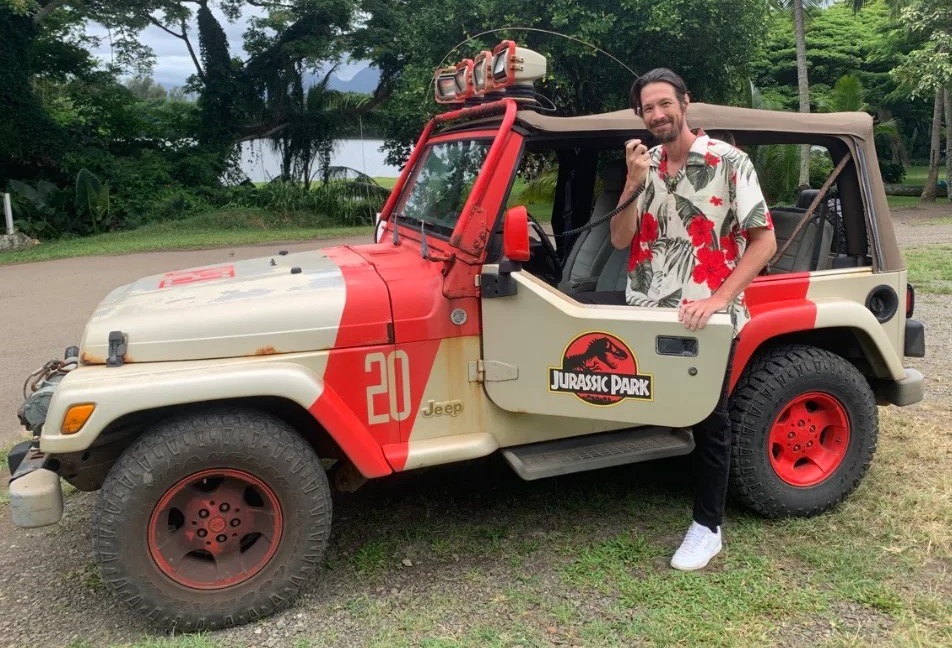
When Steven Spielberg needed a location for his 1993 film based on Michael Chriton’s
Jurassic Park novel, Hawaiʻi was chosen. Was the intent to film the world’s most famous
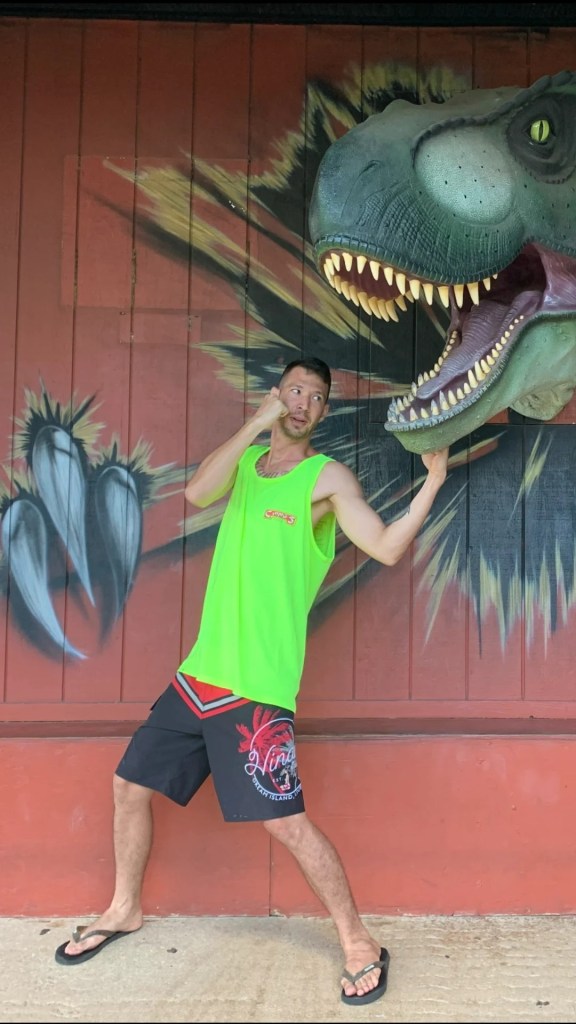
dinosaur movie in Hawaiʻi ironic or intentional? The coast you see as Jurassic Park characters are approaching “Isla Nublar” is Kauaʻi’s fabled Na Pali Coast. Is Na Pali actually named after the biblical tribe the Naphtali, who some say the Hawaiians are descendants of? We will go into the Naphtali tribe later in another section. The site of the Mano de Dios Amber Mine where a lawyer decides that a respected paleontologist is needed for the project, supposedly set in the Dominican Republic, was actually filmed near Hoopii Falls, on the Kapaa Stream. Jurassic Park’s helipad was constructed at Manawaiopuna Falls, which is only visible from the air. Was Hoopii Falls and Manawaiopuna Falls, like Manoa Falls and Rainbow Falls once inhabited by Mo’o? Filmed at Kualoa Ranch, on the island of Oʻahu, is the scene where Alan Grant and the children unfortunately find themselves in the path of a herd of Gallimimus fleeing from a T-Rex. The fallen tree under which they take shelter can be found on the ranch. In 2021, tourists can visit Kualoa Ranch, officially dubbed Jurassic Valley, where they can take pictures with statues of Dinosaurs and explore the ranch. Jurassic Valley at Kualoa boasts in advertisements that you can take an ATV and Raptor tour, A Jurassic Valley zipline ride, movie site tour, or horseback riding, among other activities. Right as you first arrive at the Honolulu International Airport, you’ll see giant 10-foot-tall posters of Kualoa Ranch and a T-Rex, promoting Jurassic Valley with slogans like: “Discover Jurassic Valley. Where legends are made.” Hawaiians already had Mo’o legends in ancient times, and thanks to Hollywood and tourism, people in modern Hawaiʻi are still fascinated with, worship, fear, and honor these reptilian creatures. The bible called them serpents or dragons; science calls them dinosaurs; the Hawaiians called them Mo’o. Hawaiʻi is literally the real-life Jurassic Park.
 Uncorrupted Truth
One thought on “Reptilians”